
TCP 10
ECOSEAL CORE | Seal with Confidence
TCP 10: Automatic Tin Collar Placer Machine for Edible Oil Tins
Fix corrugated collars on 15-litre/15-kg oil tins automatically — synchronized with your filling line, no manual placement.
Purpose-Built for Edible Oil Tin Lines
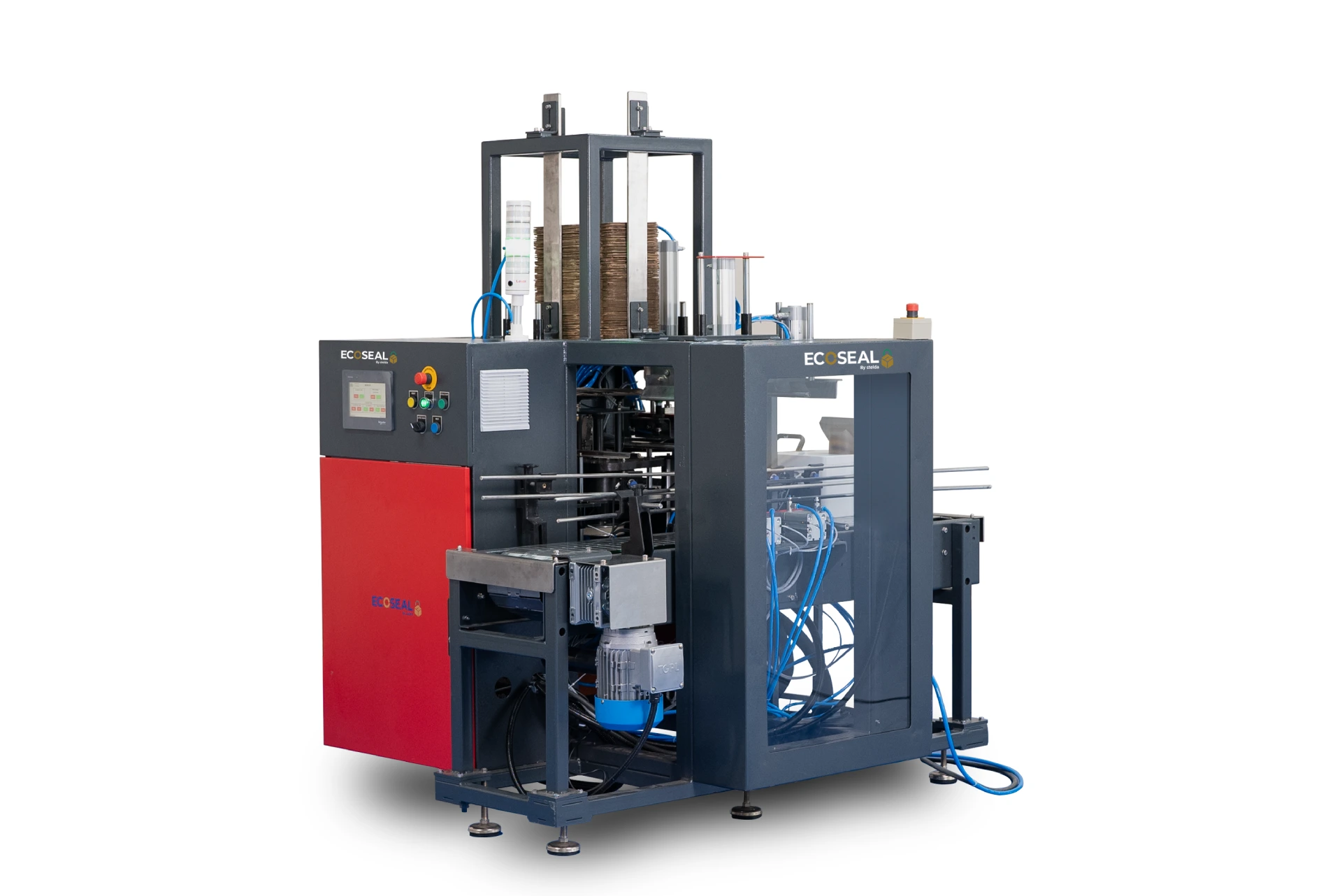
The ECOSEAL CORE TCP 10 is an automatic tin collar placer machine designed to fix corrugated collars on 15-litre and 15-kg edible oil tins without manual intervention. It synchronizes directly with your oil-filling line, matching speed so collar placement never becomes the bottleneck.
The machine handles the full cycle: collars are de-stacked and fed continuously, pulled vertically into the gluing unit, glued using a synchronized rotating-table dispenser, and pressed firmly into place — all tracked through an HMI that logs sealing data, glue patterns, and carbon footprint figures.
Three things this automatic tin collar placer machine is built around:
- Non-Stop Feeding – The collar feeder de-stacker keeps collars moving continuously into the line.
- Consistent Gluing – A synchronized rotating table and linear motion apply adhesive evenly, every cycle.
- Data You Can Act On – HMI-logged sealing, gluing pattern, and carbon footprint data — not just a working machine, a monitored one.
Detailed Specifications of the ECOSEAL CORE TCP 10
Feature
Specification
Model
TCP 10
Working Speed
Up to 10 tins / minute
Tin Dimensions
240mm (L) × 240mm (W) × 325mm (H) (+/- 3mm)
Gluing System
hhs Baumer® Dispenser
Magazine Infeed Capacity
250 collars (standard)
Electrical Requirement
3 Phase, 415V, 50 Hz, 6.8 KVA
Air Pressure Requirement
15 CFM, 6 Bar (Dry Air)
Machine Dimensions
1610mm (L) × 1770mm (W) × 1733mm (H)
Machine Standards
Built to Certifiable Standards
The STELDA TCP 10 is CE compliant. Precision gluing delivers tamper-evident packaging that is cleaner and more sustainable than manual strapping methods.
Ready to Automate Your Tin Collar Placement?
What Makes the STELDA TCP 10 Reliable

Collar Feeder (De-stacker)
Picks up collars for continuous, non-stop feeding.

Collar Erector
Collars are pulled vertically from the feeder and positioned in the gluing unit.

Synchronized Gluing Station
hhs Baumer® dispenser with rotating table and linear motion for consistent adhesive application, with error indication.

Advanced HMI Controls
Stores sealing data, gluing patterns, and carbon footprint figures, with error indications.

Programmable Glue Pattern
Precise, customizable glue application that reduces adhesive waste.
Pressing Station
Firmly attaches collars after gluing for a secure hold.
Single Conveyor System
Smooth tin movement through the collar-fixing cycle.

Interlocked Safety Doors
Electrically interlocked access doors protect operators during operation.

Custom Layout Options
Adaptable to specific plant layouts and line configurations.

Compact Footprint
Small footprint suited to space-conscious shop floors.

Glue Monitoring
Low-level sensors alert when glue needs replenishment — no unplanned stoppages.
Proven in an ECOSEAL CORE Deployment
A global agri-business leader combined ECOSEAL CORE (TCP 15 + PS 20 HM) to move away from BOPP-taped edible oil pouches and tins. The results:
Eliminated BOPP tape – shipper cartons became 100% recyclable.
Tamper-evident seals – pilferage incidents dropped.
Optimized shipper height – better cube efficiency in transit.
Faster changeovers – improved operational efficiency across the line.
Experience the
STELDA TCP 10
in Action
Contact Us for Pricing and
Custom Solutions
Frequently Asked Questions About the STELDA TCP 10
1. What is an automatic tin collar placer machine and how does the TCP 10 work?
An automatic tin collar placer machine fixes a corrugated collar onto the top of a filled oil tin using adhesive, without manual handling. The TCP 10 feeds, glues, and presses collars onto 15-litre/15-kg tins at up to 10 tins per minute, synchronized with your filling line speed.
2. What size of oil tin does the TCP 10 support?
The TCP 10 is built for 15-litre/15-kg tins measuring 240mm × 240mm × 325mm (+/- 3mm). For different tin sizes, contact STELDA to discuss custom layout options.
3. What happens if the glue supply runs low during production?
Low-level sensors monitor glue supply and alert the operator through the HMI before levels become critical — allowing a refill without an unplanned line stop.